
How UK Etsy and Amazon Sellers Can Win Every Listing Image Slot With AI Mockups

Every image slot in your listing is a conversion decision waiting to be made. On UK Etsy and Amazon, sellers competing in the etsy print on demand space rarely lose customers at checkout; they lose them in search results, in the fraction of a second it takes a shopper to scroll past a weak thumbnail. With organic CTR benchmarks of 2–3% for typical Amazon listings, with top performers exceeding 5%, the gap between a good primary image and a forgettable one is measurable in revenue.
The challenge has always been budget and speed. Professional photography costs money, takes time, and becomes obsolete the moment you launch a new design. AI mockup generation changes that equation entirely, giving sellers the ability to produce lifestyle-context visuals, channel-matched thumbnails, and even video content without a studio or a photographer.
This post walks you through every image slot on UK Etsy and Amazon, explains the rules that govern each one, and shows you a practical, systematic approach to filling them with AI-generated visuals that compete at the highest level. By the end, you will have a clear framework for turning every image position into a genuine competitive advantage.
Why Every Listing Image Slot Is a CTR Battle
On both Amazon and Etsy, your listing image is not decoration. It either earns a click or surrenders it to the next result in the grid.
Organic listings on Amazon target a click-through rate of 2 to 3%, with top performers reaching 5% or higher. The primary product image is the single biggest lever determining which side of that gap you land on. For Etsy print on demand sellers, the stakes are identical: in a scrollable grid of thumbnails, your image determines whether a buyer ever reaches your price, title, or reviews.
A shopper who scrolls past your listing does not return to reconsider. That makes every primary image slot function like a paid ad, one that must justify the click on visual merit alone.
The challenge is sharpest for print on demand sellers: most suppliers provide the same base product catalogue to every seller. When the product itself is identical, the image quality becomes the differentiator that separates listings that sell from those that do not. Visual execution is often the only competitive variable you fully control.
Image Slot Rules on UK Etsy and Amazon You Need to Know
Before building your AI mockup strategy, you need to understand exactly what each platform allows.
Amazon provides multiple image slots per listing, typically up to nine, including a dedicated video slot (verify current limits in Seller Central). The main image requires the product on a pure white background with no props, text, or additional elements. Lifestyle and context visuals belong exclusively in the supporting slots.
Etsy allows multiple media slots per listing (currently up to ten, verify in the Etsy Seller Handbook) and imposes no white-background rule on the primary image. For print on demand sellers, this is a meaningful creative advantage: your thumbnail can feature a model, a lifestyle setting, or a styled flat lay, giving you far more flexibility to compete visually in the search grid.
Both platforms support video. Amazon provides a dedicated video module within the image carousel; Etsy counts video as one of its media slots. Yet most sellers leave this slot empty.
A lifestyle image that performs strongly as an Etsy primary thumbnail would violate Amazon's main image policy outright. If you want to see how quickly you can produce the right image type for each slot, generating five professional mockups in one click takes less time than you might expect.
Why Lifestyle Context Now Outperforms Flat Product Shots
Knowing where lifestyle images belong is only half the equation. Understanding why they outperform flat product shots drives the strategy.
Shoppers respond to context, a garment worn in a natural setting answers fit and style questions that a flat lay or ghost mockup leaves open. A hoodie worn by a model outdoors answers fit, weight, and style questions before the buyer reads a single word of your description. A flat lay forces the shopper to imagine all of that themselves, and most will not bother when a competitor's listing does the work for them.
Human elements also reduce perceived purchase risk. A model wearing a garment outdoors, or hands holding an apparel item, signals the product is real, wearable, and worth trusting. Buyers calculate return likelihood before they click; lifestyle context reduces that friction.
The perceived barrier is cost. Studio shoots, models, and photographers are impractical for most independent sellers. But AI mockup generators that turn design files into professional product images in seconds close that gap entirely.
Sellers still relying on ghost mockups or flat lays are already conceding ground. The leading listings on both platforms are lifestyle-forward, and that standard is only rising.
What AI Mockup Generation Actually Solves for Print on Demand Sellers
The barrier is not visual quality, it is cost and time. Professional apparel photography, model, studio, and post-production, carries a cost that is impractical for most independent sellers at scale. For most independent print on demand sellers on Etsy and Amazon, that cost structure makes lifestyle-quality photography practically impossible at scale.
AI mockup tools change the equation entirely. Upload your design file, and channel-ready visuals are generated in seconds, no physical sample required. The output matches exactly what previous sections show converts browsers into buyers: a garment on a model, in context, at the quality level that earns the click.
Mocksy works on this principle: one click produces professional mockups for t-shirts, sweatshirts, hoodies, and tank tops across a wide range of garment models and colour options. Producing a complete image set for every listing variation, across every colourway, becomes practical without any photography budget.
The compounding effect matters most for larger catalogues. Sellers managing dozens or hundreds of SKUs across Etsy and Amazon print on demand stores can generate consistent, professional image sets at a scale that studio photography simply cannot match.
Winning the Primary Image Slot on Each Platform
With your AI mockup tool ready, the approach for each platform is straightforward but distinct.
On Amazon, the white-background requirement means you generate a clean, front-facing shot where the garment fills the frame with no props, text, or environmental context. At thumbnail scale, your print placement and colour must read instantly. A cluttered or low-contrast image loses the click before a shopper even registers your title.

On Etsy, the creative freedom in the primary slot is yours to use. A lifestyle-style mockup featuring a model wearing the garment in a natural setting stops the scroll in Etsy's grid view in a way that a flat product image simply does not. This is where the shift toward lifestyle context pays off most directly.
On both platforms, colour accuracy and print visibility are non-negotiable. Mockups drawn from a wide range of garment models and colour options give buyers a reliable preview of what they will receive, which reduces the return risk buyers factor in before clicking.
The real advantage of AI generation here is speed of iteration. Producing three primary image variations for a single listing takes minutes, not days. That makes split-testing straightforward rather than costly, and split-testing is how top-performing sellers push toward the 5% CTR threshold rather than settling at the 2–3% baseline.
Treat the primary slot as a live test, not a fixed decision. When CTR data plateaus, refreshing the image costs nothing with AI generation.
How to Fill Supporting Image Slots to Reinforce the Click
Once the primary slot earns the click, supporting slots take over a different job: converting curiosity into a purchase by answering every question a buyer still has.
On Amazon, the supporting slots give you multiple opportunities to do this. Etsy allows additional images beyond the primary. Use them deliberately.
A practical slot sequence for apparel print on demand listings:
Alternate colour variant showing the same design on a different garment colour
Close-up print detail demonstrating artwork quality and placement accuracy
Size reference on model giving buyers a realistic fit guide
Product benefits graphic covering material, wash care, or sizing information
This sequence mirrors the buyer's natural decision journey, moving from "I like it" through to "I'll buy it."
Every one of those shots is producible as an AI mockup without a physical sample. Using a tool like Mocksy, you can generate the full set from a single design file in minutes, across a wide range of garment models and colour options. That makes it practical to give every SKU its own complete gallery rather than recycling the same two images across variants.
Complete galleries signal professionalism to buyers and may positively influence platform ranking signals.
The Video Slot: The Image Position Most Sellers Leave Empty
Once you have your supporting slots covered, the video slot is the next obvious move, and it is one most print on demand sellers ignore entirely.
Both Amazon and Etsy support video within the listing media carousel, yet the video slot is underused by most apparel sellers, which means filling it is one of the few remaining low-competition advantages available right now.
A 15 to 30 second clip showing a garment in wear, in motion, or being styled does something static images cannot: it answers questions about fit, drape, and movement before the buyer has to guess. That reduces hesitation and supports the conversion that follows the click.
You do not need a film crew to occupy this slot. Your existing AI mockup images can serve as the raw material. A simple slideshow of your strongest mockup variations, with light motion or animated transitions, is quick to produce and functional enough to signal listing completeness to platform algorithms.
More ambitious sellers can take this further, using their AI mockup assets as a visual reference and storyboard for a short filmed clip. Keeping the same garment models and colourways across your stills and video reinforces a coherent visual identity throughout the listing.
The competitive window here is genuinely open. Fill it before it closes.
Split Testing Your AI Mockups to Push CTR Higher
Filling the video slot edges you ahead of sellers relying on static images alone. The next lever is ensuring your primary image is the strongest option available.
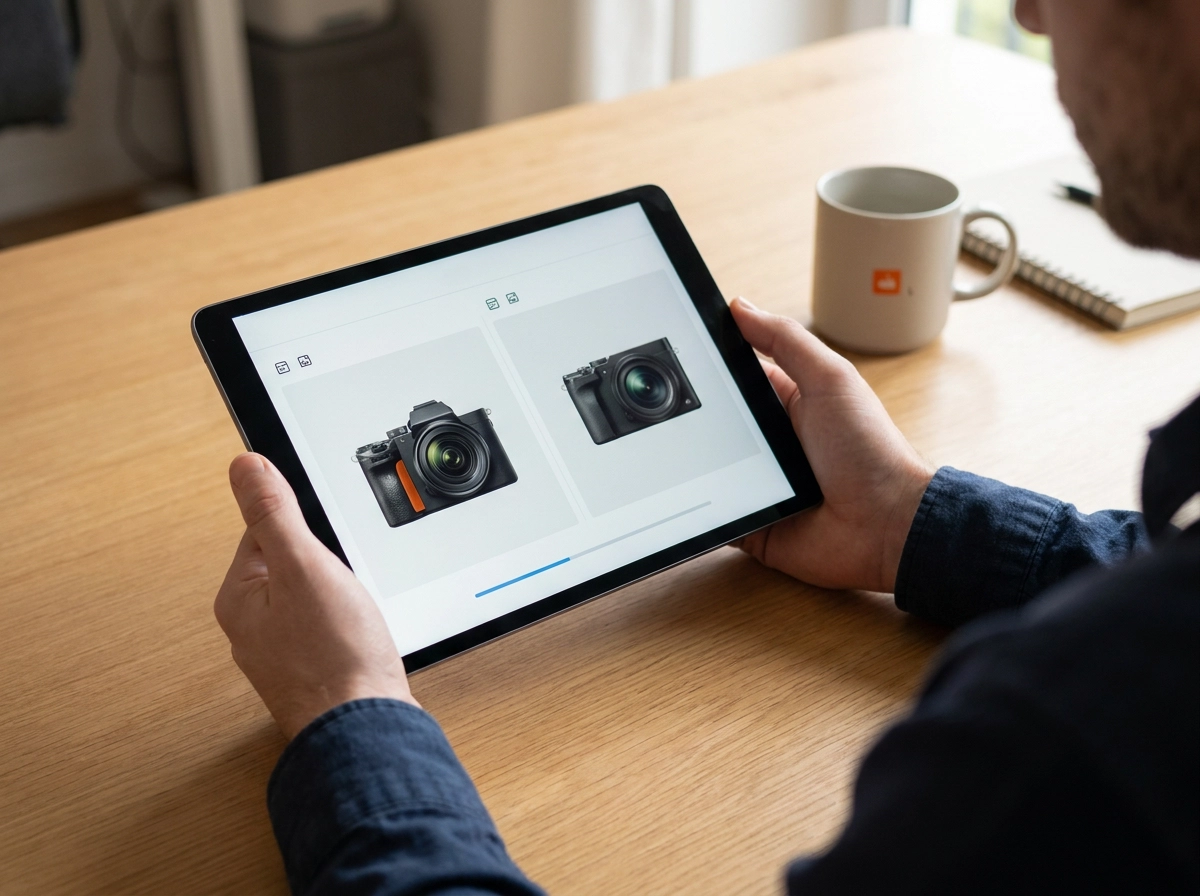
Split testing primary images is one of the most direct ways to push CTR higher. Previously, producing multiple variants meant additional photography costs, making iterative testing impractical. AI mockup generation reduces this to minutes, making A/B testing a repeatable part of routine listing management.
The mechanics differ by platform. On Amazon, the Manage Your Experiments tool supports direct A/B testing of main images, serving each variant to a split audience and reporting performance data. Etsy does not currently offer a native split-testing tool; manually rotate images and track CTR changes through your shop statistics over comparable date periods.
Variables worth testing include:
Lifestyle versus white-background primary images (where platform rules permit)
Model choice and garment fit representation
Colourway featured in the thumbnail
Print size and placement visibility at thumbnail scale
The most important discipline is closing the feedback loop. When a specific model style or colourway consistently lifts CTR, standardise it as your default mockup template for new listings. Each test compounds into a more accurate brief for your next product launch.
A Practical Starting Point for Sellers Ready to Act
Once you have a testing framework in place, the simplest way to act on it is to start small and build momentum from there.
Pick your three highest-traffic listings and generate a fresh, complete image set for each. That focused scope gives you real CTR data without touching the rest of your catalogue.

Try before you commit. Mocksy lets you generate mockups to test quality before committing, check the current free tier and plan options on the Mocksy site.
Match each mockup to its platform slot. For Amazon, generate a clean white-background front-facing shot for the primary slot. For Etsy, use a lifestyle-style model image as your thumbnail. Fill the remaining slots on both platforms with supporting angles, print detail shots, and colour variants.
Keep a simple tracking log with four columns: listing URL, image version, date changed, and weekly CTR. Four data points per listing is enough to identify which mockup styles are lifting performance and which to scale.
The end goal is a repeatable workflow: upload your design, generate a full image set in one click, fill every slot, log the CTR, and lock in your best-performing variant as the template for every new launch.
Takeaways: Turn Every Image Slot Into a Competitive Advantage
The framework is straightforward to carry forward.
The slot mapping is simple to remember:
Amazon primary: clean, white-background shot
Etsy primary: lifestyle-context model image
Secondary slots: alternate angles, colourways, and detail shots
Video slot: motion or slideshow content built from your strongest mockups
Split-testing is what separates sellers plateauing at 2 to 3% CTR from those consistently hitting 5% and above. AI generation makes each test iteration essentially free, so there is no reason to leave a primary image untested.
Start with three listings, generate three full image sets, fill every slot, and track CTR weekly. The data will tell you which mockup styles to scale. Build that loop once, and it compounds across every new product you launch.
Conclusion
Every image slot in your Etsy or Amazon listing is a decision point, and most sellers are leaving those decisions to chance.
The path forward is straightforward: map your primary images to platform rules, fill supporting slots with context and detail, use the video slot your competitors ignore, and test variants until your CTR data tells you what wins.
Visual quality is no longer a barrier reserved for sellers with large budgets. The system is ready to build, start with your three highest-traffic listings and let the numbers guide what comes next.