
Why UK POD Sellers Ignore Their Second-Most-Viewed Product Image
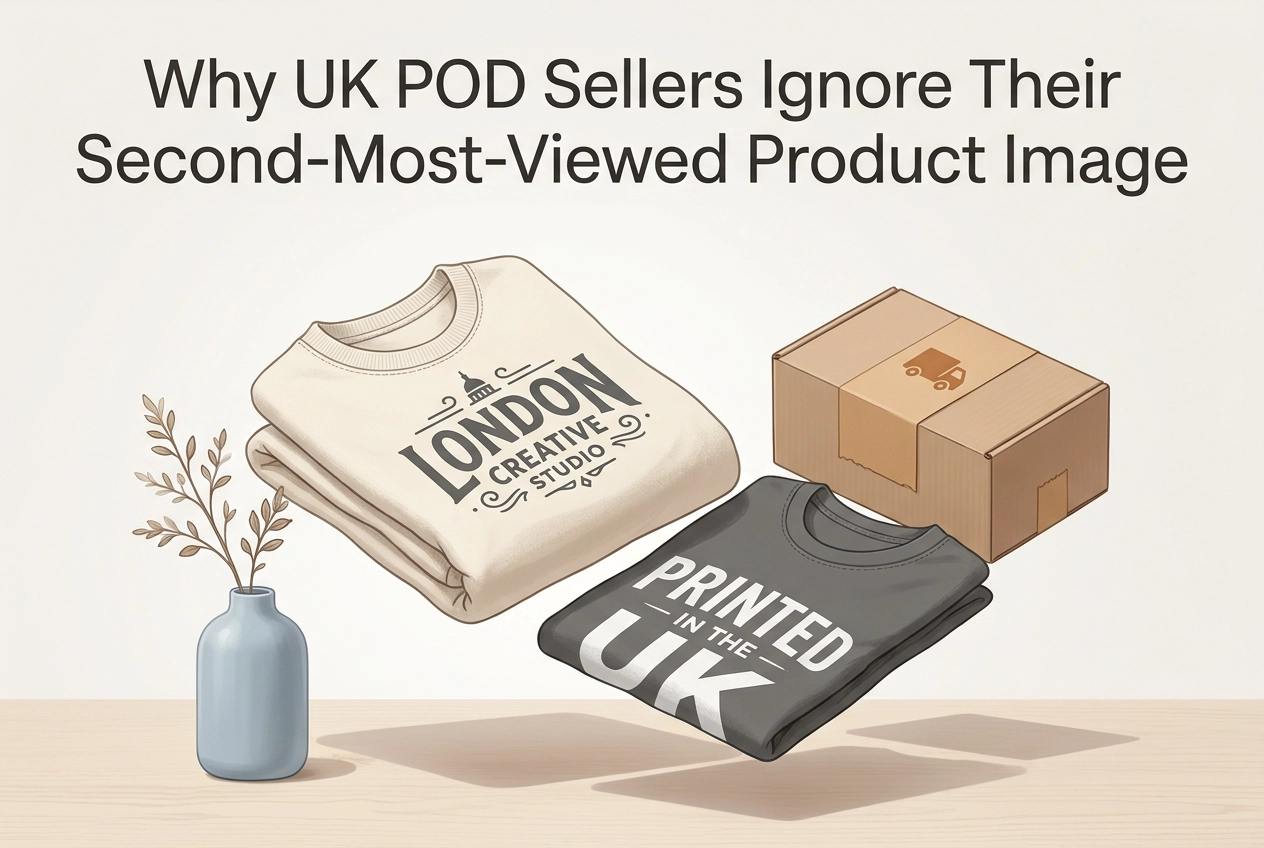
You have spent hours perfecting your hero image. The lighting is right, the mockup looks clean, and the product sits front and centre exactly where it should. So why are some of your listings quietly underperforming, even when the main image is solid?
Here is a possibility worth sitting with: the problem is not your hero image. It is the image slot you are barely thinking about.
For UK print-on-demand sellers, packaging mockups represent one of the most underused conversion assets in a listing stack. While the hero image gets all the creative energy, the packaging image slot, particularly on Etsy and Amazon UK, is often the silent deciding factor for gift buyers and repeat purchasers who want reassurance before they commit.
In this post, we are going to look at why that second image slot gets ignored, what the UK market actually tells us about buyer expectations around packaging, and how adding even one strong packaging mockup to your listings can deliver disproportionate results for minimal extra effort. If you are at the stage where small optimisations matter, this one is worth your attention.
The Hero Image Gets All the Love, And That Is the Problem
Ask most UK print-on-demand sellers where they spend their listing prep time, and the answer is almost always the same: the hero image. Getting that first photo perfect makes sense, but it creates a blind spot. Etsy allows up to ten images per listing, and Amazon UK supports multiple views, yet the majority of independent POD sellers populate one or two slots and consider the job done.
The packaging image slot is the most consistently empty slot in that carousel, and it is quietly costing sellers conversions.
The assumption driving this neglect is that buyers care only about the product itself. For straightforward purchases, that might hold. But a substantial chunk of UK marketplace traffic is gift-motivated, and gift buyers think differently. They are not just evaluating a hoodie or a card; they are picturing how it will land with the recipient. A listing that only shows the garment forces the buyer to imagine the rest. A listing with a packaging image answers the unspoken question before it becomes doubt.
When two similar listings sit side by side at a comparable price, the buyer moves through the image carousel. A strong packaging image in slot two or three can be the tiebreaker, because it communicates care and quality in a way the hero image simply cannot.
This tunnel vision is not the seller's fault. POD tutorials, YouTube channels, and community guides are almost entirely focused on garment visuals and print mockups. Packaging mockups rarely feature, which means most sellers have never been prompted to consider them a conversion asset at all. As weak product visuals quietly cost UK marketplace sellers real revenue, the gap in education compounds the gap in listings.
Packaging Mockups in the POD Context: What We Are Actually Talking About
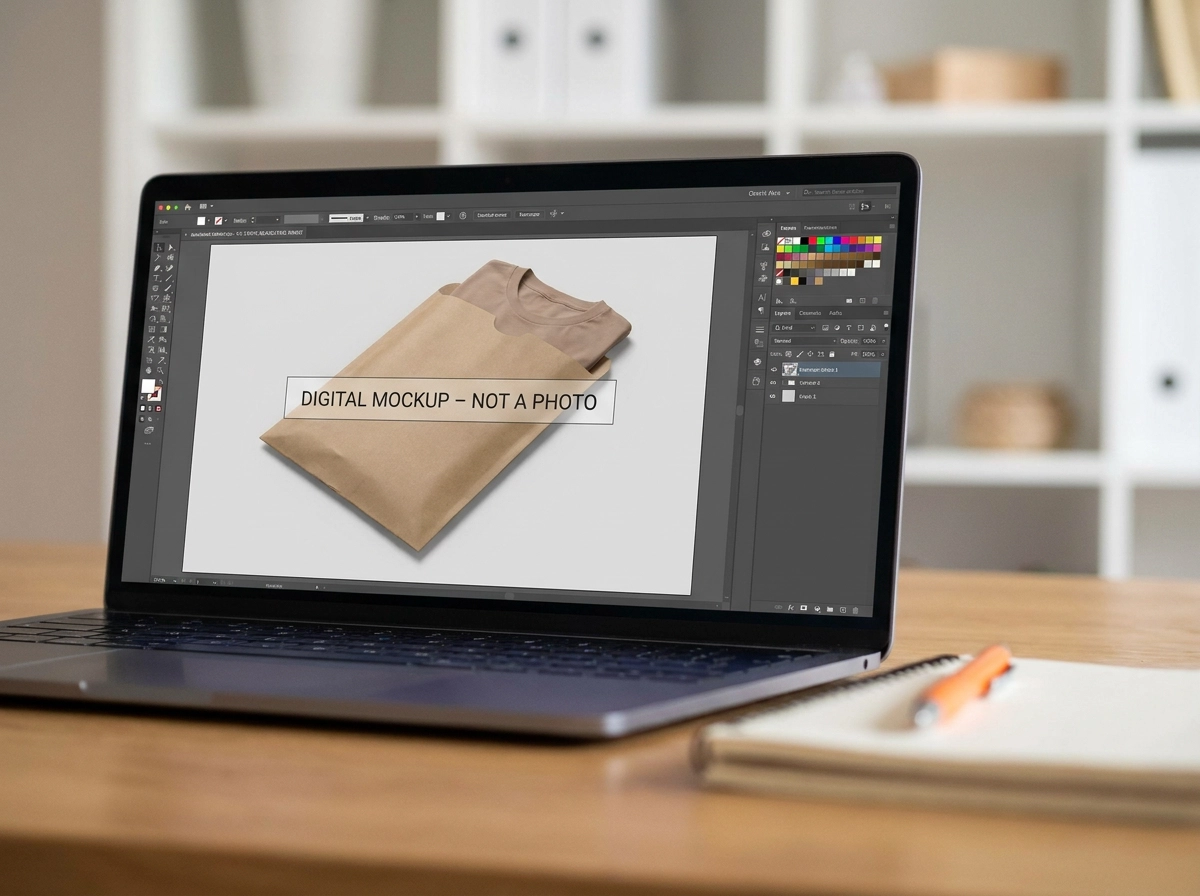
Before defining what packaging mockups are, it helps to be precise about what they are not. They are not photographs of physical parcels, and they do not require a warehouse full of branded boxes.
In the POD context, a packaging mockup is a digital visualisation of the arrival experience: a folded hoodie nestled in white tissue paper, a poly mailer laid flat with a hang tag visible, a thank-you card tucked beside a printed insert. The goal is to show buyers what lands on their doorstep, not just what the product looks like on a white background.
The range of elements these mockups can feature is broader than most sellers realise: mailer boxes, poly bags, tissue paper, hang tags, branded inserts, and loyalty cards all qualify. Print on demand cards sit in their own category here. A greeting card, postcard, or loyalty card has very different presentation needs compared to an apparel item; shown in an envelope, a kraft sleeve, or a ribbon-tied stack, it communicates its own sense of occasion and care.
This is not the same thing as manufacturing mockups used by large retailers, which are part of a physical production and QA process. POD packaging mockups are purely digital assets built for conversion, created to answer buyer questions through visuals the same way an AI mockup generator answers them for garment designs.
The bar is genuinely low. A well-composed lifestyle image of a folded garment in plain tissue paper communicates care and quality just as effectively as a fully branded box. What matters is answering the buyer's unspoken question: will this look like a proper gift when it arrives? That is the single job this image slot exists to do.
What the UK Packaging Market Tells Us About Buyer Expectations
That question of "will it look like a proper gift?" sits within a much bigger commercial story.
The UK e-commerce packaging market was valued at $3,593.7 million in 2025 and is projected to reach $4,389.4 million by 2030. That is not incidental spend. Retailers, logistics providers, and brands are actively investing in packaging as a differentiation tool, not just a delivery mechanism. Market research confirms that UK businesses are pouring resource into innovative packaging designs specifically to strengthen brand identity and improve the unboxing experience.
Sustainability is a significant part of that shift. UK consumers increasingly expect eco-friendly, recyclable, and minimal packaging, and they notice when brands communicate those values visually. Between 2025 and 2030, accelerated adoption of recyclable and compostable formats is expected as retailers respond to both regulatory pressure and changing consumer preferences.
Here is what this means for independent sellers. When large retailers invest at this scale in packaging as a brand asset, buyer expectations rise across the board. A customer who regularly orders from well-presented brands carries those expectations into every purchase, including the £25 hoodie they are buying from an Etsy shop. They do not consciously apply a lower standard to independent sellers; they simply expect the experience to feel considered.
The good news is that POD sellers face a much lower barrier than large retailers. You do not need to invest in custom physical packaging. You need to show buyers what your packaging looks like. That is a visual problem, and visual problems have inexpensive solutions.
The Gift Buyer Factor: Why Packaging Images Convert Differently
Those rising buyer expectations are shaped, in large part, by who is actually shopping on UK Etsy and why they are there.
A substantial share of Etsy traffic is gift-motivated. Birthdays, anniversaries, seasonal occasions, weddings: these are searches where presentation carries as much weight as the product itself. Etsy has pointed to steady demand for personalised gifts as a consistent revenue driver, and the UK personalised gifts market is large enough to be tracked by major industry analysts. This is a core purchasing motivation for a significant slice of your potential customers.
Gift buyers behave differently from personal shoppers: they are not just evaluating the product. They are mentally rehearsing the moment the recipient opens it. Does it look considered? Will it feel like a proper gift or an afterthought stuffed in a poly bag? Packaging imagery answers that question directly. A listing without it forces the buyer to guess, and uncertainty at that point typically means they keep scrolling.
Remove the uncertainty, and you remove friction.
Repeat purchasers follow a similar logic. A buyer who had a positive unboxing experience will look for visual confirmation of that same quality before buying again. A packaging image in the carousel is that confirmation. It signals consistency and care without requiring a single word of copy.
This is also where print on demand products can punch above their weight. A thoughtfully presented packaging mockup communicates the same visual quality as an established retail brand, with no additional production cost. Learning to generate professional mockups efficiently is the first step toward building that kind of listing presence systematically.
Why Most UK POD Sellers Still Skip the Packaging Image Slot
So if packaging images are this influential with gift buyers, why are most POD listings still missing them? The answer is a mix of bad assumptions, habit, and bandwidth.
The education gap is the biggest culprit. POD tutorials, YouTube channels, and community threads overwhelmingly focus on garment mockups and print placement. Packaging mockups are rarely framed as a listing strategy at all, so sellers simply do not think to include them. It is not a deliberate choice; it is an invisible gap.
A common misconception compounds the problem. Many sellers assume creating a packaging mockup means sourcing physical samples, hiring a photographer, or spending money they do not have. In reality, well-crafted digital mockups achieve the same visual result without any of that overhead. The barrier is perceived, not actual.
There is also a telling signal in what the research does not say. Despite the UK e-commerce packaging market being valued at over $3.5 billion in 2025, there is no meaningful industry data specifically tracking POD packaging mockup adoption. Market analysts have not studied it. That absence confirms just how underexplored this space is, and it points directly to an early-mover advantage for sellers willing to act now.
Cognitive load plays a quiet but significant role too. Sellers juggling design, fulfilment, pricing, and customer service default to the minimum viable listing. Packaging slots feel optional, so they get skipped.
Finally, there is a persistent myth that buyers only study the hero image. Carousel engagement patterns consistently show that shoppers, particularly those buying gifts or higher-priced items, click through multiple images before committing. The packaging slot is not background noise; it is part of the decision.
High Leverage, Minimal Extra Effort: The Case for Acting on This Now
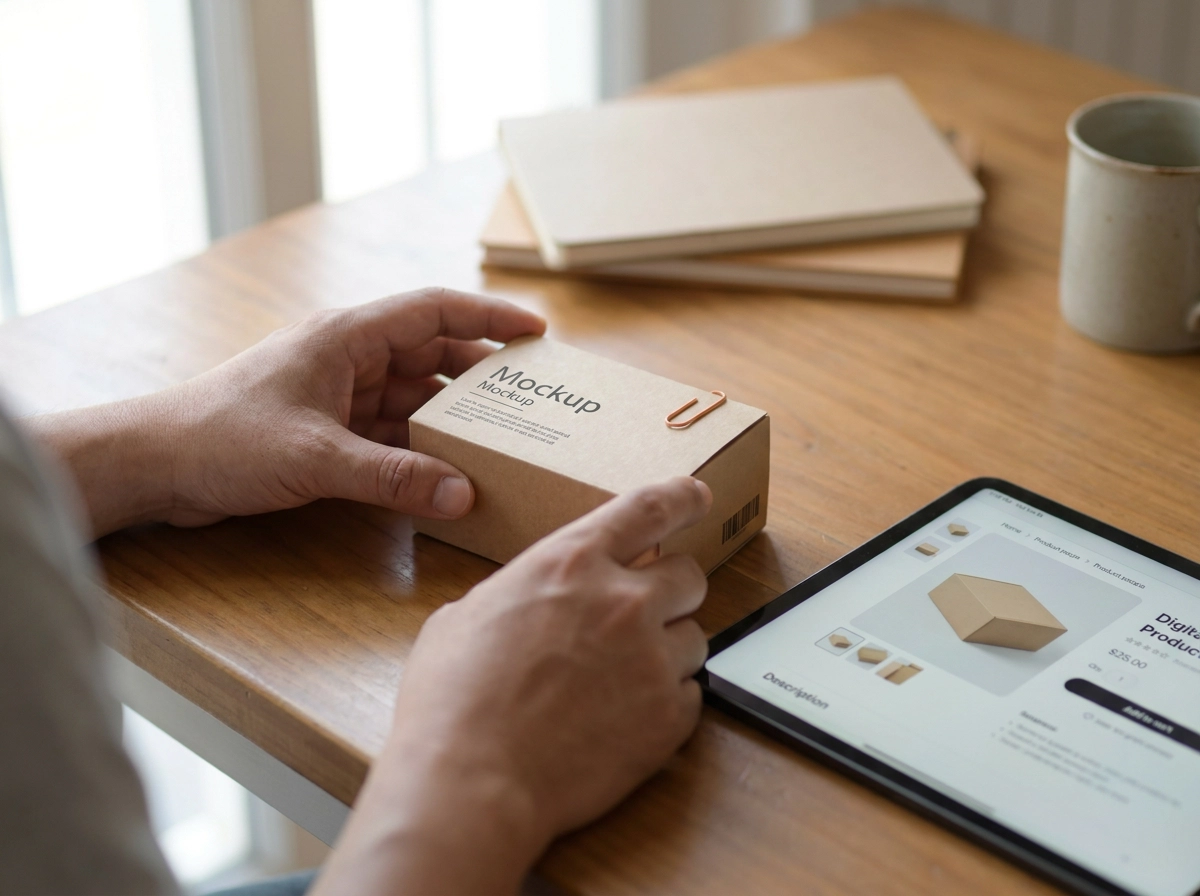
So the gap is well-documented. The more useful question is: what does it actually cost you to close it?
The honest answer is very little. Adding one or two packaging mockups to an existing listing touches nothing operational. No fulfilment changes, no pricing adjustments, no product alterations. It is a purely visual upgrade, and the only investment is the time it takes to create the image.
That asymmetry is the real insight here. Most competing listings leave those image slots empty, which means a single strong packaging mockup immediately separates your listing from the majority in your niche. You are not outspending competitors; you are simply showing up more completely than they do.
The conversion impact is disproportionate relative to that effort, particularly for gift buyers. A packaging image removes the mental uncertainty that causes hesitation at the point of purchase. For print on demand cards, small prints, and accessories, this matters even more. The perceived value of a greetings card or a postcard is almost entirely tied to presentation; without a packaging image, the listing undersells the product by default.
For apparel sellers, the mental shift required is smaller than it might seem. If you are already building out garment mockups for your t-shirt or hoodie listings, you have already developed the habit. Applying that same thinking to packaging visuals is an extension of existing behaviour, not a new workflow to learn from scratch.
The effort is minimal. The image slot is there. The process works simply once you commit to treating it as part of your listing stack, and for sellers who want a cleaner, faster route to professional results, upgrading your toolkit makes that even more straightforward.
Where to Start: Building a Packaging Mockup Into Your Listing Stack
So you've made the case for why packaging mockups matter. Here is how to actually add them without overcomplicating your workflow.
Start with a listing audit. Open your active listings and note which image slots are empty or filled with weak secondary images. Prioritise gift-category products and anything priced above £20, as these are the listings where packaging imagery has the greatest influence on buyer confidence.
One mockup can do a lot of work. You do not need a unique packaging image for every listing. A single tissue paper flatlay, a branded mailer shot, or a hang tag close-up can serve an entire product category. Create it once, use it across multiple listings.
Make your packaging image carry brand values, not just presentation. If your POD supplier uses recyclable mailers or eco-friendly materials, show that visually. UK buyers are increasingly attuned to sustainability cues, and a clean image communicating thoughtful packaging reinforces trust without requiring any copy.
For apparel sellers, sort your garment mockup stack first. Strong product imagery is the foundation; packaging visuals come second. Mocksy lets you generate professional t-shirt, hoodie, and sweatshirt mockups in one click, across 157 colour options, so your core imagery is covered quickly. With that foundation in place, adding a packaging image becomes a small, focused task rather than another item on an already long list. You can try Mocksy free with three mockups and no registration required.
Think of the carousel as a story. The hero image introduces the product, secondary images add detail and context, and the packaging image closes the sequence by showing the buyer precisely what will arrive on their doorstep or in their recipient's hands.
The Packaging Image Slot Is a Quiet Conversion Asset, Start Using It
The case has been made in full. The UK packaging market is growing, buyer expectations are rising, gift-purchasers want to see the whole experience before they commit, and the packaging image slot sits largely empty across most POD listings. That combination is not a problem; it is an opening.
Adding a packaging mockup is not extra work layered on top of what you already do. It is smarter use of the image real estate your listing already has. One additional image, placed deliberately, does a job your hero image simply cannot.
For apparel sellers, the practical path is clear. Use Mocksy to handle your garment mockup stack quickly, generating professional visuals across 157 colour options in a single click. That efficiency buys back time you can redirect toward filling those overlooked packaging slots. You can try it free with three mockups and no registration required, so the barrier to getting started is genuinely zero.
The early-mover advantage is worth taking seriously. Because packaging mockup adoption in the POD space remains low, acting now means standing out before the approach becomes standard. Once every competing listing has a packaging image, the advantage disappears. Right now, it has not.
Start small. Pick one listing, add one packaging image, and track what changes. The effort is minimal. For any product that sits in a gift category, the potential conversion upside is anything but.
Conclusion
The opportunity is sitting in plain sight. UK buyers expect premium packaging experiences, gift purchasers make decisions based on the full unboxing journey, and the second-most-viewed image slot in most POD listings remains completely untouched. That gap represents real, uncaptured conversions.
The key takeaways are straightforward: packaging mockups address a genuine buyer expectation, they convert differently because they speak directly to gift purchasers, and low adoption across the POD space means the early-mover advantage is still available to sellers who act now.
The effort required is minimal. One listing, one packaging image, one honest look at what changes in your metrics.
Use tools like Mocksy to handle your garment mockups efficiently, then redirect that saved time toward filling the slots your competitors are ignoring. The sellers who move first will benefit most. Start today.